
What is a patent?
A patent literally refers to exclusive rights and interests. The term 'patent' comes from the Latin word Litterae patents, which means a public letter or document used by medieval monarchs to issue a certificate of privilege. Later, it referred to a certificate of exclusive rights personally signed by the King of England.
In modern times, patents are generally issued by government agencies or regional organizations representing several countries based on applications. This type of document records the content of the invention and creation, and creates a legal state within a certain period of time, that is, the patented invention and creation can only be implemented by others with the permission of the patentee in general.
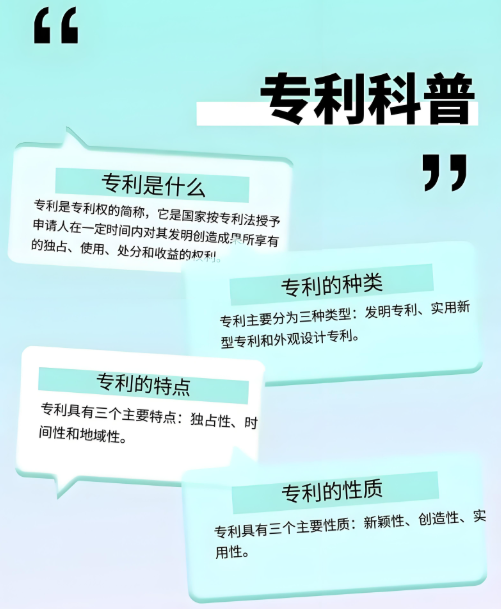
Patents in China are divided into three types: invention patents, utility model patents, and design patents.
The China National Intellectual Property Administration of the People's Republic of China is directly under the State Council in charge of national patent work and overall coordination of foreign-related intellectual property matters.
Invention Patent Application Process
China National Intellectual Property Administration [1] ("National Intellectual Property Administration, PRC", or "China National Intellectual Property Administration"). Officially referred to as "CNIPA" [2]), formerly known as the Patent Office of the People's Republic of China (hereinafter referred to as the China Patent Office), it was established in 1980 with the approval of the State Council. In 1998, the State Council reformed its organizational structure, and the China Patent Office was renamed the China National Intellectual Property Administration, which became a directly affiliated institution of the State Council, responsible for patent work and coordinating foreign-related intellectual property matters. Among them, the Patent Office of the China National Intellectual Property Administration is set up under the China National Intellectual Property Administration to uniformly accept and review patent applications and grant patent rights according to law. In 2018, we will deepen the institutional reform of the State Council, integrate the responsibilities of the China National Intellectual Property Administration, the trademark management responsibilities of the State Administration for Industry and Commerce, and the geographical indications of origin management responsibilities of the General Administration of Quality Supervision, Inspection and Quarantine of the People's Republic of China, and re establish the China National Intellectual Property Administration, which will be managed by the State Market Supervision and Administration. The main responsibilities are to protect intellectual property rights, promote the construction of the intellectual property protection system, be responsible for the registration and administrative rulings of trademarks, patents, and geographical indications of origin, and guide the enforcement of trademarks and patents.
At the same time, the people's governments of each province, autonomous region, and municipality directly under the central government generally have intellectual property offices responsible for patent management within their respective administrative regions.
Patent Literature
Patent literature, as the most effective carrier of technical information, encompasses over 90% of the latest global technical information. Compared to information provided by general technical publications, it is 5-6 years earlier. Moreover, 70% to 80% of inventions and creations are only disclosed through patent literature and are not found in other scientific literature. Compared to other forms of literature, patents have more novel and practical features. It can be seen that patent literature is the world's largest source of technical information, and according to empirical statistical analysis, patent literature contains 90% to 95% of the world's scientific and technological information.
Such enormous information resources are far from being fully utilized by people. In fact, for business organizations, patents are the only place where competitors have to disclose certain key information to the public that is not disclosed elsewhere. Therefore, analysts of enterprise competitive intelligence can obtain a large amount of useful information from patent literature through meticulous, rigorous, comprehensive, and relevant analysis, and make the publicly available patent information useful to the enterprise, thereby realizing its unique economic value. Frequently consulting patent literature in scientific research can not only improve the starting point and level of research projects, but also save about 60% of research time and 40% of research funding.
Patents are divided into valid patents and invalid patents based on the ownership of the holder.
valid patent
The commonly referred to valid patent refers to a patent that is still in a valid state after the patent application is granted. To keep a patent in a valid state, firstly, the patent right is still within the statutory protection period, and secondly, the patentee needs to pay the annual fee according to regulations.
Invalid patent
After a patent application is granted, if the patent right is lost due to exceeding the statutory protection period or due to the patent owner's failure to pay the patent annual fee in a timely manner, or if the patent is declared invalid by any individual or organization after being recognized and declared invalid by the Patent Reexamination Board, it is called an invalid patent. Invalid patents no longer have binding force on the use of the technology involved









Please first Loginlater ~